

• Latest
  • Trending
  • All
  • News
  • Business
  • Lifestyle
Scientists Confirm New Moon in Solar System

Scientists Confirm New Moon in Solar System

November 29, 2021

Hegseth cuts ties with Harvard over differences with Trump: ‘We focus on training warriors, not wokesters’

February 7, 2026

Hegseth cuts ties with Harvard over military training: ‘Training warriors, not wokesters’ amid Trump feud

February 7, 2026

Hegseth cuts ties with Harvard over Trump feud, emphasizing focus on warrior training, not ‘wokesters’ – See why!

February 7, 2026

Hegseth announces Purple Heart for National Guard members shot in DC ambush by Afghan national

February 7, 2026

Hegseth announces Purple Heart for National Guard members shot in DC ambush by Afghan national

February 6, 2026

SBA Helps Californians by Freezing Over 100,000 Borrowers in $9B Pandemic Fraud Crackdown

February 6, 2026

SBA prevents fraud for over 100,000 California borrowers in $9B pandemic crackdown.

February 6, 2026

Passionate Conservative Promises to Remove ‘RINOs’ in Fight for Open Florida Seat vacated by Vern Buchanan.

February 6, 2026

Learn why federal intervention was triggered by anti-ICE clashes – constitutional experts weigh in!

February 6, 2026

Fox News exposes top teachers’ union and anti-ICE agitator network in campus radicals newsletter – read more!

February 6, 2026

House GOP Rep. Mark Amodei to retire, cites perfect timing

February 6, 2026

Another federal judge stops the IRS from sharing addresses with ICE – click here to find out more!

February 6, 2026
  • Trending Topics:    
  • 2024 Election
  • Joe Biden
  • Donald Trump
  • Congress
  • Faith
  • Sports
  • Immigration
Saturday, February 7, 2026
IJR
  • Politics
  • US News
  • Commentary
  • World News
  • Faith
  • Latest Headlines
No Result
View All Result
IJR
No Result
View All Result
Home FaithTap

Scientists Confirm New Moon in Solar System

by Western Journal
November 29, 2021 at 7:50 am
in FaithTap, News
235 18
0
Scientists Confirm New Moon in Solar System

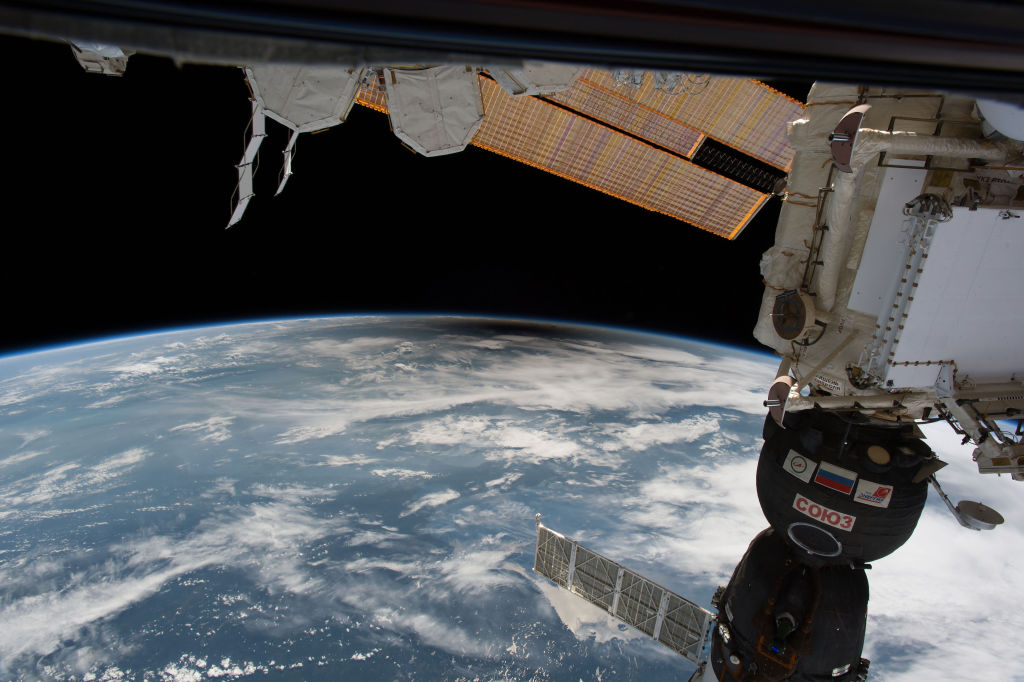
IN SPACE - AUGUST 21: In this NASA handout, the umbra, or moon's shadow, passes over Earth during the total eclipse Monday, August 21, 2017. Viewing the eclipse from orbit were NASA's Randy Bresnik, Jack Fischer and Peggy Whitson, ESA (European Space Agency's) Paolo Nespoli, and Roscosmos Commander Fyodor Yurchikhin and Sergey Ryazanskiy. The space station crossed the path of the eclipse three times as it orbited above the continental United States at an altitude of 250 miles. (Photo by NASA via Getty Images)

491
SHARES
1.4k
VIEWS
Share on FacebookShare on Twitter

Leaving a wobbly track through space, a tiny mini-moon orbits the Sun, coming relatively close to Earth along its path.

Intrigued by this scrap of rock, which is about 164 feet across, scientists have been trying to figure out how the little moonlet got there. They have decided it is nothing more than a chip off the old block.

The moonlet bears a grand name — Kamo’oalewa, which is a Hawaiian word that roughly translates to “the oscillating celestial fragment,” according to Live Science.

Good luck trying to find it, because on its closest approach to Earth it is about 40 times farther than the 239,000 mile distance that separates us from the moon, and its orbit can take it as far as 100 times farther, according to Time.

The chunk of space rock’s orbit gets warped by the competing gravitational pulls of the sun and Earth.

“It’s primarily influenced just by the sun’s gravity, but this pattern shows up because it’s also — but not quite — on an Earth-like orbit. So it’s this sort of odd dance,” said graduate student Ben Sharkey of the Lunar and Planetary Laboratory at the University of Arizona, who is the lead author of a recent paper trying to identify the moonlet’s origins, Time reported.

A visit was out of the question, so using Earth-based instruments to gather data, they learned enough to know that the little critter was similar to most asteroids, in that it was made from similar material, but it was different, in that the infrared signature didn’t match.

The question was resolved when Sharkey went back in the archives to review a study of moon samples brought back to Earth by the crew of Apollo 14 in 1971.

Bingo. The results were a match.

“Visually, what you’re seeing is weathered silicate,” Sharkey said. “The eons of exposure to space environment and the micrometeorite impacts, it’s almost like a fingerprint and it’s hard to miss.”

The moonlet’s origins are guesswork, but given that the moon is whacked over and over by rocks whizzing through space, pieces fly off the surface routinely.

Kamo`oalewa, an odd asteroid that orbits in lock-step with the Earth, may be a chunk of the Moon that was broken off during a huge, ancient collision.
Just imagine watching that happen…https://t.co/D5pVwOKkuW pic.twitter.com/AuRarCNPgO

— Corey S. Powell (@coreyspowell) November 12, 2021

Most pieces are tiny, and many burn up in the atmosphere as meteorites.

Kamo’oalewa, however, wandered off into its own path.

“We see thousands of craters on the moon, so some of this lunar ejecta has to be sticking around in space,” Sharkey said.

Although the moonlet will not endure where it is forever, there is no rush for stargazers to hunt it down with telescopes.

In the big picture of cosmic time, the moonlet has about 300 more years to wobble in its eccentric orbit before it simply spins off into parts unknown.

This article appeared originally on The Western Journal.

Tags: HawaiiscienceSpaceU.S. News
Share196Tweet123

Join Over 6M Subscribers

We’re organizing an online community to elevate trusted voices on all sides so that you can be fully informed.


IJR

    Copyright © 2024 IJR

Trusted Voices On All Sides

  • About Us
  • GDPR Privacy Policy
  • Terms of Service
  • Editorial Standards & Corrections Policy
  • Subscribe to IJR

Follow Us

No Result
View All Result
  • Politics
  • US News
  • Commentary
  • World News
  • Faith
  • Latest Headlines

    Copyright © 2024 IJR

Welcome Back!

Login to your account below

Forgotten Password?

Retrieve your password

Please enter your username or email address to reset your password.

Log In

Thanks for reading IJR

Create your free account or log in to continue reading

Please enter a valid email
Forgot password?

By providing your information, you are entitled to Independent Journal Review`s email news updates free of charge. You also agree to our Privacy Policy and newsletter email usage